Free Shipping on orders over $199


 1-800-452-1261


Log In
Free Shipping on orders over $199


Price: $76.99
This item is available for pre-order and will be ready to ship in July.
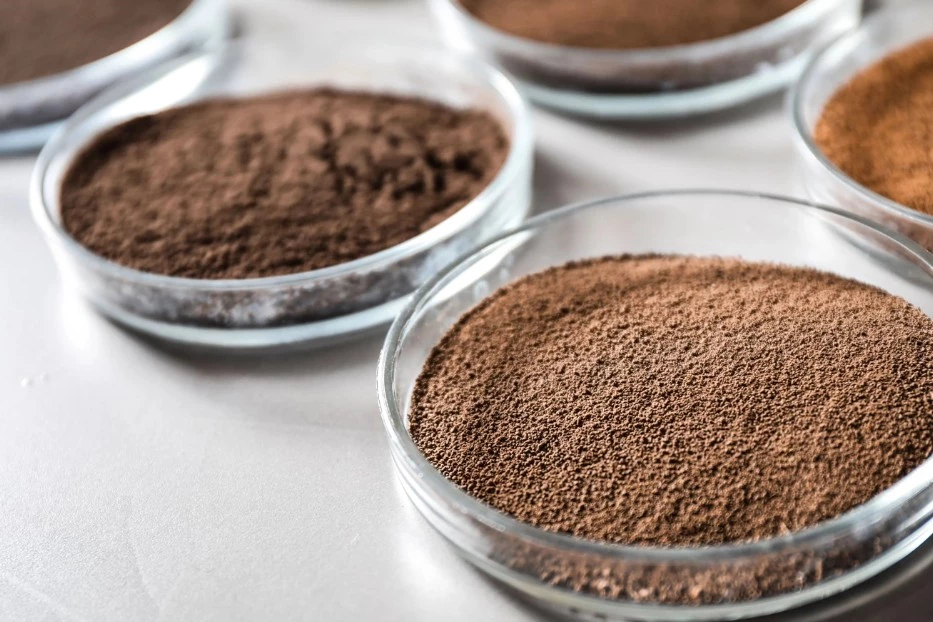
Students explore how the physical and chemical properties of soil impact soil quality through a three-part investigation: determining soil texture using particle settling, measuring water holding capacity across soil types, and evaluating pH, nitrate, and phosphate levels. Aligned to AP® Environmental Science Unit 4: Earth Systems and Resources. Activity includes materials listed, student packets with guided-inquiry procedures, and teacher notes with real sample data. Also, access to editable versions on Google Docs or Word as they become available.
This item can only be shipped to schools, museums and science centers
Overview
In this inquiry lab, students explore how the physical and chemical properties of soil impact soil quality through a three-part investigation. In Part A, students determine soil texture—the relative amounts of sand, silt, and clay—by measuring particle settling rates after mixing soil with softened water and using the USDA soil texture triangle to classify their sample. In Part B, students measure the water holding capacity of three different soil samples to understand how texture influences water retention. In Part C, students evaluate the chemical properties of soil by measuring pH and testing for the presence of essential macronutrients (nitrates and phosphates), then assess soil fertility and the environmental impact of nutrient runoff.
AP® Course and Exam Description Alignment
This activity is aligned to the 2024 AP® Environmental Science Course and Exam Description, Unit 4: Earth Systems and Resources.
Learning Objectives addressed:
● ERT-4.B: Describe the characteristics and formation of soil.
● ERT-4.C: Describe similarities and differences between properties of different soil types.
Science Practices addressed:
SP 1.A, 1.C (Describe and explain environmental concepts in applied contexts)
SP 2.A (Describe characteristics of an environmental concept represented visually)
SP 5.B, 5.C, 5.E (Describe relationships, explain patterns, and explain what data implies about environmental issues)
SP 6.C (Calculate an accurate numeric answer with appropriate units)
SP 7.A (Describe environmental problems).
Exam Connect questions are included, featuring both free-response and multiple-choice questions aligned to Unit 4 topics and science practices.
Key Features
Real sample data included. Kit instructions always include real sample data—never made up! Teachers have complete sample data tables for all three parts with calculated answers to guide expectations.
Tested and optimized. Each experiment has been thoroughly tested, retested, and optimized to guarantee safety and success.
Prelab questions build foundational understanding of soil horizons, texture classification, and chemical fertility. Three guided procedures progress from physical analysis to chemical testing, and post-lab questions move from calculation to data interpretation to environmental application.
Flexible and adaptable. Students can collect and test soil from their own surroundings to compare with classroom samples. The three parts can be run independently across multiple class periods.
Teacher Notes
Estimated Time: Part A (soil texture) can be completed in one 50-minute class period, with a final observation the next day. Part B (water holding capacity) can be completed in one 50-minute class period. Part C (chemical properties) can be completed in less than one 50-minute class period.
Kit accommodates 15 groups of students.
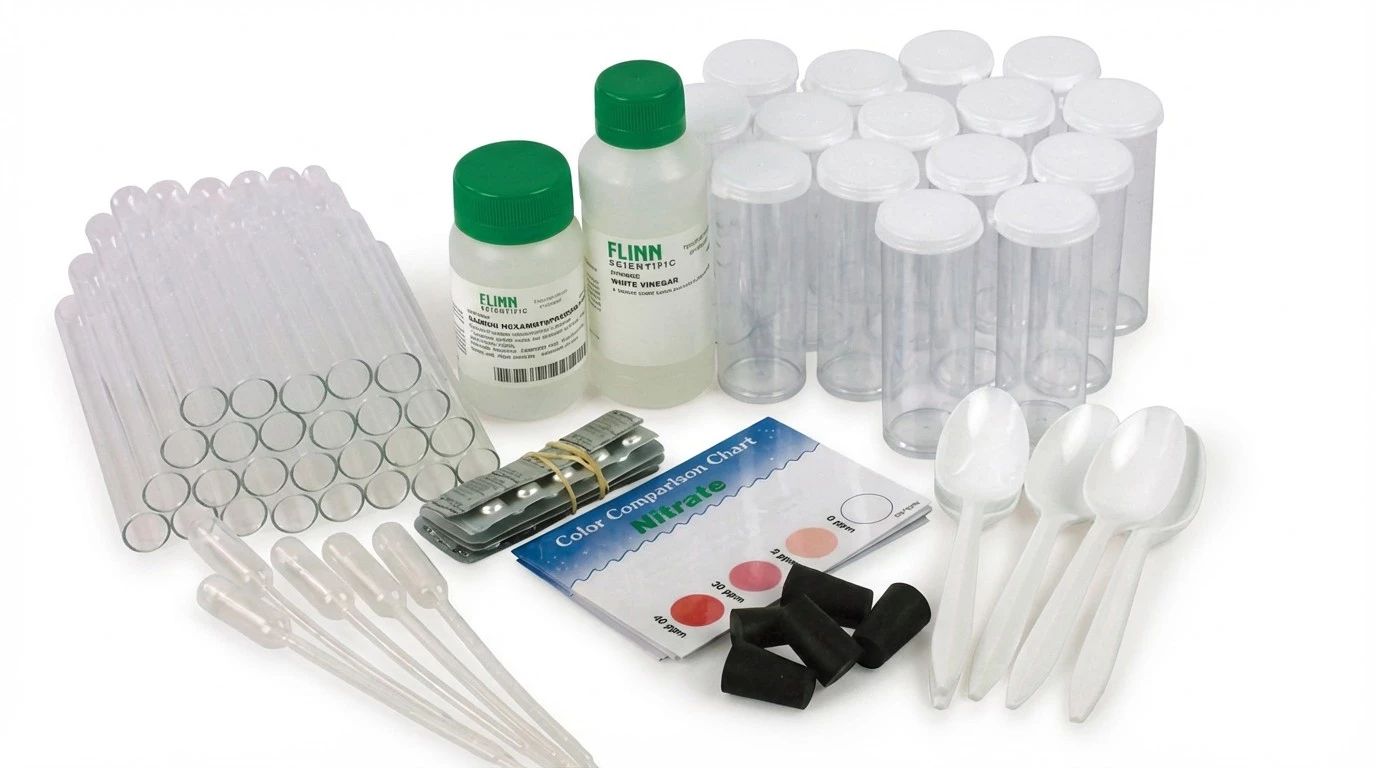
Materials: Kit includes white vinegar, sodium hexametaphosphate, Beral pipets (graduated), stoppers, nitrate/phosphate/pH TesTab tablets, color comparison charts, vials (snap-on cap), plastic spoons, culture tubes, and filter paper.
Additional Materials: Graduated cylinders; beakers; timer or watch; ruler (metric); distilled water; soil samples; funnels; balance; permanent marker; tap water; test tube rack.
Advanced Preparation: Teacher needs to create 5% sodium hexametaphosphate solution. Soil samples must air-dry on newspaper for 1–2 days prior to lab. Each group needs approximately 100–150 g of soil total across all three parts.
Safety: TesTab tablets contain small amounts of chemicals that may irritate skin. Wear chemical splash goggles and chemical-resistant gloves. Do not handle soil with bare hands.
Materials Included in Kit:
White vinegar, 50 mL; Sodium hexametaphosphate, 1 g; Beral pipet, graduated, 20; Stopper, rubber, size #0, 15; Nitrate wide range TesTab, 15; Phosphate TesTab, 15; Wide range pH TesTab, 15; Wide range pH color comparison chart, 5; Nitrate color comparison chart, 5; Phosphate color comparison chart, 5; Vial, snap-on cap, 50 mL, 15; Plastic spoon, 15; Culture tubes, 16 × 150 mm, 75; Filter paper, pk/100, 1. Student packet, copy-ready with structured response spaces; Teacher packet with answers, data, and sample observations.
Additional Materials Required (per group):
Graduated cylinder, 10 or 25 mL; Graduated cylinder, 50 mL; Graduated cylinder, 100 mL, 4; Beaker, 100 mL, 3; Timer or watch; Ruler, metric, mm; Water, distilled, 250 mL; Soil samples, two or more options, 400 g each; Funnel, 3; Balance; Permanent marker; Water, tap; Test tube rack
Materials Accessible Online:
Student Packet in Google Doc and Microsoft Word formats. Teacher Notes without key.